
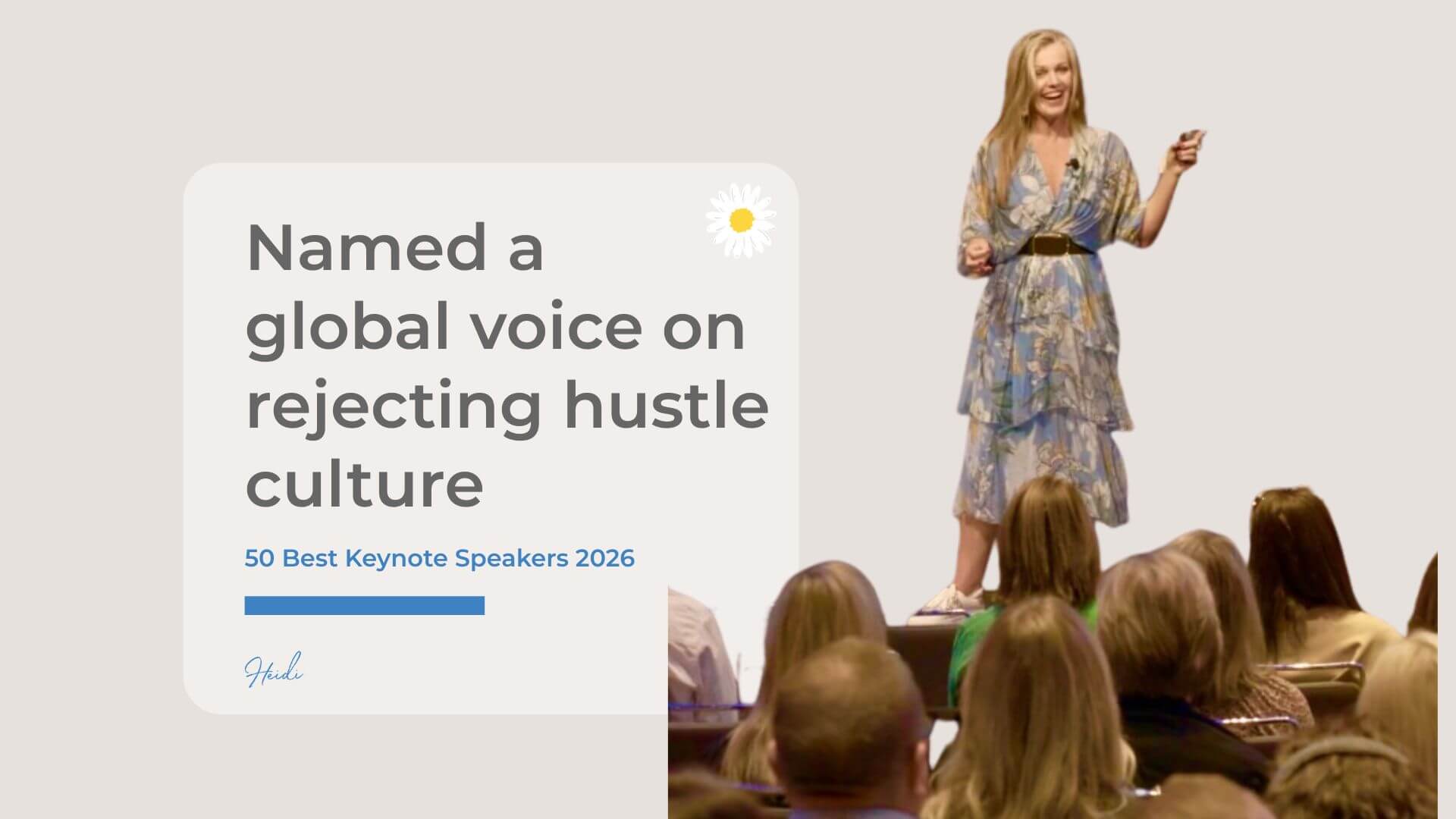
I was genuinely grateful to be included in the 50 Best Keynote Speakers on Rejecting Hustle Culture (2026), in the Global and Cross-Cultural Voices category.
It was a very lovely moment. When someone independently recognises work you have spent years developing, particularly as part of a global collection, there is absolutely room for a small happy dance.
The bigger reason this recognition means so much to me is the conversation Jonno White (who researched and curated the list) is helping bring to conference stages and workplaces around the world.
He has brought together thinkers, researchers, physicians, Olympians, authors, speakers and practitioners who are questioning the belief that exhaustion proves commitment, or that constant pressure is simply the price we must pay for meaningful success.
Somewhere along the way, many workplaces began treating long hours, constant availability and running ourselves into the ground as evidence that we care deeply about our work. Capable people may be able to keep that pace going for a while, but eventually our judgement, relationships, creativity and performance pay the price.
My work has always centred on helping people perform under pressure without sacrificing every ounce of capacity in the process. Being included in the Global and Cross-Cultural Voices category feels like meaningful acknowledgement that this conversation matters across industries, countries and cultures.
Why rejecting hustle culture belongs on conference stages
Conference audiences are already living with the effects of hustle culture, even when nobody uses that exact phrase.
They are managing full calendars, constant change, tighter deadlines, ongoing technology updates and the expectation to remain available for everything, everywhere, all at once. Add in the pressure to lead well, support others and still deliver results, and it is little wonder so many capable professionals are running on fumes.
Of course, employees do not always have complete control over these pressures. Workload, staffing levels, deadlines, leadership expectations and the culture of an organisation can all influence how people are expected to work. Organisations have a responsibility to examine the conditions they are creating, because this conversation cannot become another way of asking individuals to cope better with unreasonable demands.
This is why the conversation belongs on conference stages.
People do not need another message telling them to push harder, wake up earlier or squeeze more into an already overflowing day. They need practical ways to protect their capacity, make better decisions under pressure and continue doing meaningful work without treating exhaustion as a professional achievement.
While we may not be able to control every demand placed upon us, we can become clearer about what sits within our influence. This is where professional resilience becomes practical. We can notice when our capacity is running low, question unhelpful expectations, seek support, choose how we respond and make intentional decisions about what happens next.
Rejecting hustle culture does not mean lowering standards or caring less about results. It means questioning the habits and expectations that keep people busy while their judgement, creativity and connection begin to suffer.
For event organisers, this topic also opens the door to a much bigger conversation about leadership, performance and the kind of workplace culture organisations are creating. When it is handled well, audiences leave with more than agreement that overwork is a problem. They leave with useful ideas about what organisations can improve and what individuals can begin doing differently when they return to work.
What Global and Cross-Cultural Voices means to me
Being included in the Global and Cross-Cultural Voices category felt especially meaningful because it reflects the way I have built my work over many years.
I speak to audiences across APAC and internationally, and every room is different. The pressures facing a leadership team in Fiji may not be the same as those facing finance professionals in Sydney, association members in Singapore or a large international audience in Dubai. The core ideas may travel, but the examples, language and context need to feel relevant to the people sitting in front of me.
That means I spend a great deal of time before an event understanding the audience, the industry, the challenges they are facing and what the organiser wants the session to achieve. I do not want people thinking, “Well, that was interesting, but it had nothing to do with us.”
For me, tailoring a keynote is about respect. It shows the audience that their culture, circumstances and professional realities matter. It also helps the ideas land in a way that people can actually use when they return to work.
Living and working in the Pacific has also influenced the way I think about leadership, connection and performance. I have seen how much we can learn when we stop assuming there is only one way to work, lead or succeed. Different cultures can offer very different perspectives on community, ambition, support and what a meaningful life looks like.
That is why the category feels like more than a label. It acknowledges the international and cross-cultural perspective I bring to my work, and the care I take to make each keynote relevant to the people, place and purpose of the event.
Living and working by choice, not chance
One of the biggest decisions I have made in my own life was to stop assuming success had to look a certain way.
For a long time, I did what many high-achieving professionals do. I worked hard, said yes often, carried a great deal of responsibility and kept moving because there was always another goal, deadline or person relying on me.
But the more life tested me, the clearer it became that I did not want my future to be built entirely around expectations I had never properly questioned.
That is one of the reasons I chose to build my life and work across Australia and the Pacific. It reflects a belief I come back to often: we can create our lives by choice, not chance.
For me, that does not mean avoiding ambition or stepping away from meaningful work. I care deeply about what I do, the audiences I serve and the impact I create. It means being intentional about the way I work, the decisions I make and the kind of life those decisions are creating over time.
That same thinking sits inside much of what I teach.
We cannot control every deadline, restructure, difficult leader, budget decision or unexpected challenge. We can, however, become more aware of our response. We can protect our capacity, ask for support, focus on what sits within our influence, remain adaptable and acknowledge the micro-wins that keep us moving.
These choices may look small in the moment, but they shape how we perform, how we lead and how we feel about the person we are becoming through our work.
Rejecting hustle culture, for me, is about refusing to let our calendar make every important decision on our behalf. It is about noticing when achievement has started costing too much, then making one intentional choice that moves us towards a more sustainable way of working and living.
How professional resilience challenges hustle culture
Professional resilience is sometimes misunderstood as the ability to keep pushing, keep coping and somehow keep everything together no matter what work throws at us.
That is not how I see it.
To me, professional resilience is the ability to remain clear-headed, future-focused and intentional when pressure is unavoidable. It helps us make better decisions, protect our credibility, use support well and keep contributing without pretending we have endless capacity.
This matters because resilience should never become a convenient excuse for organisations to keep increasing demands while expecting employees to absorb the impact. Leaders still need to look honestly at workload, priorities, staffing, expectations and the everyday behaviours their culture rewards.
At the same time, there will always be things at work that sit outside our control. A restructure may go ahead. A deadline may remain. A client may still be difficult. Technology may continue changing faster than we can say, “Hang on, where did that button go?”
This is where the practical side of professional resilience helps.
We can notice when pressure is affecting our judgement. We can pause before reacting. We can ask for support before the wheels start wobbling. We can focus our energy on what we can influence, adapt when the original plan no longer works and protect enough capacity to keep making thoughtful decisions.
Those habits do not remove organisational responsibility. They give us more choice in the moments where our own response still matters.
For me, rejecting hustle culture and building professional resilience belong in the same conversation. One challenges the unhealthy expectations that can become normal at work. The other gives leaders and professionals practical ways to respond with greater intention while those broader workplace changes are being made.
How this thinking appears in my keynote
These ideas are woven through my keynote, The Self-Leadership Advantage: How Adversity Becomes a Choice Point, Not an End Point.
Using the petrol bomb attack and the catastrophic Vanuatu earthquake as the two central stories, I explore how adversity can become a Choice Point. It is the moment where we decide how we will respond, what we will carry forward and what needs to change.
The keynote draws on Pacific Wisdom to help audiences think differently about performance, pressure and connection, while giving them practical ways to protect their capability, adapt and keep moving forward when circumstances are far from ideal.
For me, this is where rejecting hustle culture becomes practical. We can still care deeply about our work, pursue meaningful goals and perform at a high level, while making more intentional choices about the way we get there.
A grateful final reflection
Being included in this global list is a lovely recognition of the work I have built over many years, but it also feels like encouragement to keep contributing to a conversation that matters.
I am grateful to Jonno for bringing together such a wide range of voices and for recognising that meaningful performance should not require people to spend their careers running on empty.
For me, rejecting hustle culture is about making more intentional choices. It is about creating careers, workplaces and lives by choice, not chance, while still doing work that matters and holding ourselves to high professional standards.
That is the work I will continue bringing to conference stages across APAC and internationally: helping people respond to pressure with greater clarity, protect the capability behind their performance and decide what they want their next Choice Point to lead to.
You can explore my keynote topics and speaker profile to learn more about the stories, practical frameworks and cross-cultural perspective I bring to events.
And when you are planning a conference and would like to talk through your audience, event goals and the message that would be most useful for them, you are very welcome to book a Clarity Conversation.
Frequently asked questions
What does rejecting hustle culture mean?
Rejecting hustle culture means questioning the belief that long hours, constant availability and exhaustion are proof of commitment. It does not mean caring less about our work. It means creating a more intentional way of working where performance can be sustained without people running themselves into the ground.
Does rejecting hustle culture mean lowering performance standards?
No. High standards, ambition and meaningful work still matter. The difference is that success is not measured by how depleted people become while achieving it.
Sustainable performance asks us to look at the quality of decisions, the value of the work and whether people can continue contributing effectively over time.
How does professional resilience support sustainable performance?
Professional resilience helps us remain future-focused when work becomes demanding. It shapes how we respond under pressure, use support, adapt when circumstances change and protect the capacity behind our performance.
It is a practical workplace capability rather than an expectation that people should keep absorbing unreasonable pressure.
Why is hustle culture an important topic for conference audiences?
Many conference audiences are dealing with full workloads, constant change, competing priorities and pressure to remain available. A keynote speaker on rejecting hustle culture can help people examine the beliefs driving those expectations and consider more practical ways to perform under pressure.
The conversation also gives organisations an opportunity to think about the conditions they create, while helping individuals focus on the choices still available to them.
Why does cross-cultural relevance matter when choosing a keynote speaker?
Audiences across APAC do not all experience leadership, performance or workplace pressure in the same way. Industry, location, culture and professional expectations all influence how a message is received.
A speaker with cross-cultural experience takes the time to understand the people in the room and adapts the language, examples and practical learning so the keynote feels relevant to that particular audience. This is especially important for event organisers who need a speaker capable of connecting with diverse international audiences.


